
What to ask about return-to-sport testing after ACL surgery
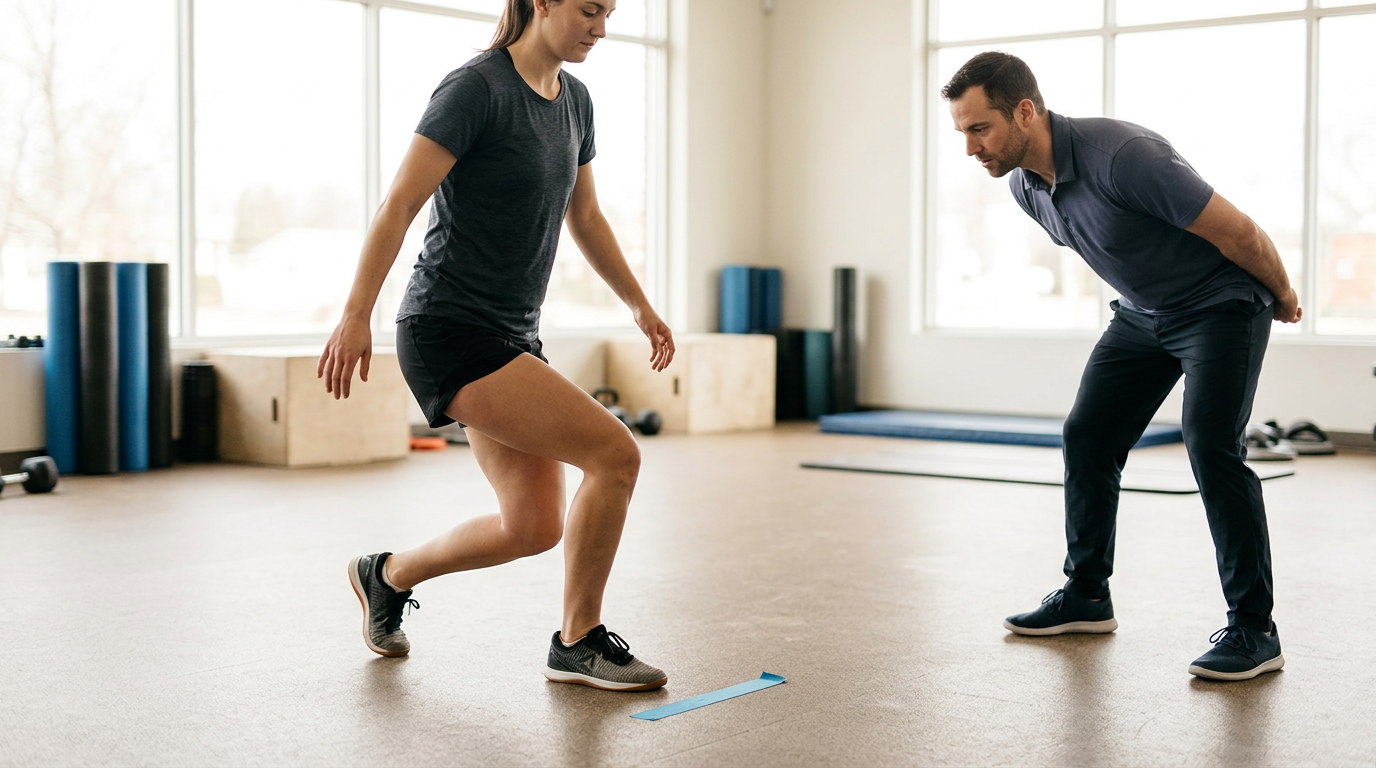
Bring the full test report to your surgeon or physical therapist (PT). After anterior cruciate ligament (ACL) reconstruction, ask them to show you which finding supports your next activity, what the test did not measure, and what would change the plan. If you play a sport that involves pivoting, cutting, or landing, ask which parts of your next practice you can join and which are still off limits. [1]
Name the activity you want to return to
The Panther Symposium consensus group describes return as a progression. These distinctions can help you and your clinician tell whether you’re discussing the same goal. [1]
- Return to participation. You’re taking part in training, perhaps with limits. Joining passing drills without a defender is participation, even if you’re not ready for a game.
- Return to sport. You’re playing your sport again at your previous level of competition, but you may not yet play as well as you did before injury.
- Return to performance. You can perform at your preinjury level again. For a defender, that might mean keeping up with an opponent through an unexpected turn as well as you did before injury.
Write down the decision you want help with. Can I defend during a scrimmage? gives your care team a specific activity to assess Our ACL recovery timeline gives background on recovery, but time since surgery doesn’t answer that practice question by itself. [1]
Read the report with your clinician
Have the dated report open during the visit. Bring any earlier results, including preseason testing if you have it. Beside each item below, note measured, observed, or not tested. A blank doesn’t necessarily mean you need another test today. Ask whether the missing information matters for the activity you want to add.
Strength. What could each leg produce? Ask for the separate results for your quadriceps, the muscles at the front of your thigh that straighten your knee, and your hamstrings, the muscles at the back that bend it. A limb symmetry index compares one leg’s result with the other’s. If both legs are weaker than before, they can look well matched. Wellsandt and colleagues found that recovery often looked better when athletes’ legs were compared on the same day than when the operated leg was compared with the other leg’s earlier, presurgery result. The researchers used that earlier measurement to estimate what athletes might have been able to do before injury. [2]
Ask to see each leg’s result in its original units. Did the operated side improve, did the other side lose strength, or did both change? If there’s no comparable preinjury test, ask whether there are reference results from people who play a similar sport at a similar level and were tested the same way. The Aspetar guideline suggests comparing strength with reference values for the sport and activity level. Ask your care team why the benchmark fits your goal. [3]
Hopping and landing. Did anyone assess how I moved? Kotsifaki and colleagues studied male athletes already cleared for sport and compared them with healthy male athletes. Within the surgery group, the two legs hopped nearly the same distance, but the operated knee did less work during push-off and absorbed less on landing. [4] If your report lists only distance, ask what your PT noticed at takeoff and touchdown. If there’s video, ask them to show you the difference they want to work on. A distance alone can’t show it.
Changing direction. Did I know where I was going? Return-to-sport assessment can include how you change direction. [3] Think about which turns your sport asks of you, from rounding a cone to changing course when an opponent moves. Ask whether the tester timed you, watched how you slowed down and planted on each side, or also asked you to react to a cue. Think about repeated stops late in a drill, an unexpected pass, or landing with someone nearby. Which of those demands has your PT seen, and which still needs a supervised assessment?
Symptoms and examination. How did my knee respond? Tell your clinician about pain, swelling, or a sense of giving way during or after activity you’ve already been cleared to do. Ask how that account fits with the examination, including how far the knee bends and straightens, whether there’s swelling, and how stable it feels when tested. If you completed the test but noticed swelling later, ask whether that changes what you may do at practice. [1] [3]
Confidence. Which movement am I still avoiding? Be specific about when you trust your knee and when you hesitate. You may feel comfortable landing alone but hold back when another player contests the ball. Ask whether a readiness questionnaire would help you and your PT track that concern, and how your answer would shape supervised practice. Your care team can weigh your confidence alongside the physical examination and testing. [1] [5]
Decide what the results change
A test can identify something to work on without predicting whether you’ll tear an ACL again. In one study of male professionals, athletes who missed discharge criteria before team training had more tears of the reconstructed ligament. A newer registry study of athletes ages 15 to 35 at surgery who returned to their previous level found no clear link between the number of strength and hop tests passed and a subsequent ACL injury to either knee. The studies tested different things and counted different injuries. Neither can turn your score into personal odds or clear you for a game. [6] [7]
Fictional example. Maya, a recreational soccer defender, brings a report showing similar hop distances and good control on planned turns. She wants to scrimmage. Her PT hasn’t seen her react to an opponent, and Maya says she hesitates when a forward reverses direction. Her care team agrees she can join unopposed passing at modified practice. For now, turns in response to a cue stay in supervised rehab. Her PT will reassess those turns and ask how her knee responds afterward. They set a visit to review the findings before reconsidering scrimmage. Full competition is a separate decision.
Questions to ask your physician
- Which finding most affects my next step? If several things need work, which should my PT and I focus on first, and what would improvement look like?
- Does healing of the reconstructed ligament still limit me? If I also had a meniscus repair, damage to the cartilage covering the joint, or another ligament injury, how does that change which tasks you’ll allow?
- What belongs only in supervised rehab? At modified practice, may I join planned drills, react to other players, or take contact? What remains off limits in full practice and competition?
- Who on my care team clears each change? Who will explain the limits to my coach or teammates?
- When will we reassess, which test or observation will we repeat, and what result would make you advance, hold, or revise the plan?
My take-home plan
- Allowed now ______
- Supervised only ______
- Still off limits ______
- Priority before retesting ______
- Who will reassess, and when ______
For background on the supervised part of your plan, see our postoperative ACL rehabilitation guide.
Request an appointment or Call Dr. Millstein’s office at 310-595-1030.
Learn More
- Return to Sport After Anterior Cruciate Ligament Injury: Panther Symposium ACL Injury Return to Sport Consensus Group — Meredith SJ et al. 2020.
- Limb Symmetry Indexes Can Overestimate Knee Function After Anterior Cruciate Ligament Injury — Wellsandt E, Failla MJ, and Snyder-Mackler L. 2017.
- Aspetar clinical practice guideline on rehabilitation after anterior cruciate ligament reconstruction — Kotsifaki R et al. 2023.
- Single leg hop for distance symmetry masks lower limb biomechanics: time to discuss hop distance as decision criterion for return to sport after ACL reconstruction? — Kotsifaki A et al. 2022.
- APKASS 2024 consensus statement on anterior cruciate ligament reconstruction, part Ⅲ: Return to play after anterior cruciate ligament reconstruction — Liang Z et al. 2026.
- Likelihood of ACL graft rupture: not meeting six clinical discharge criteria before return to sport is associated with a four times greater risk of rupture — Kyritsis P et al. 2016.
- Is the number of strength and hop tests passed at the time of return to pre-injury sport level associated with second ACL injury? A registry study of 458 patients — Högberg J et al. 2026.