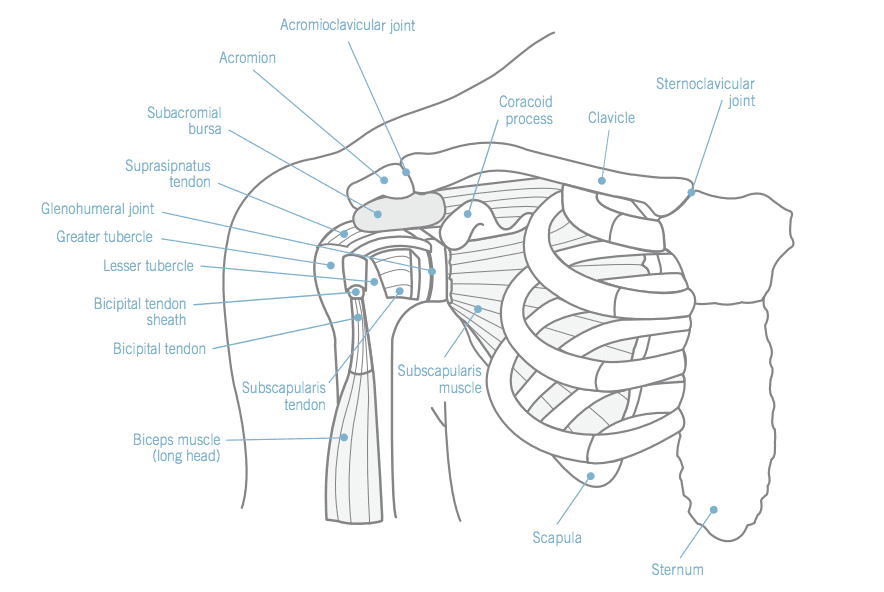
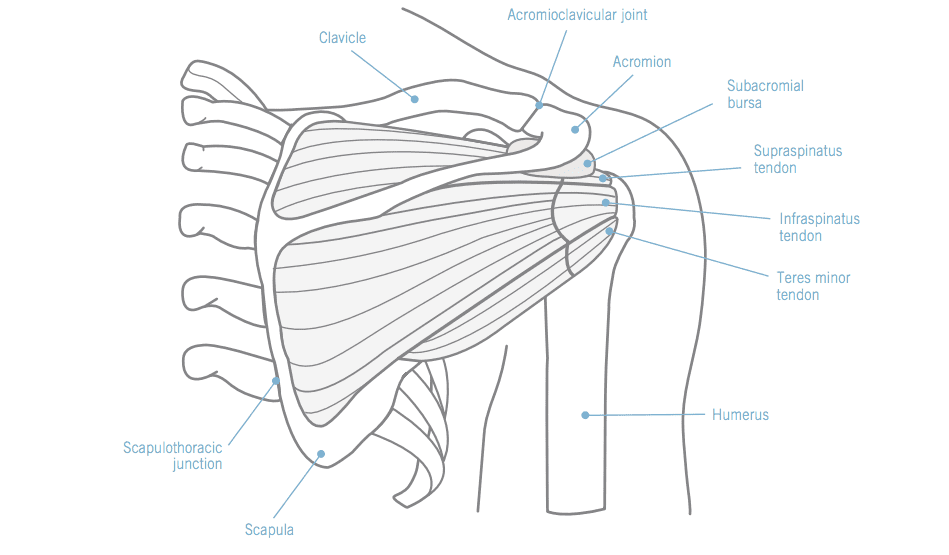
THE GLENOHUMERAL JOINT
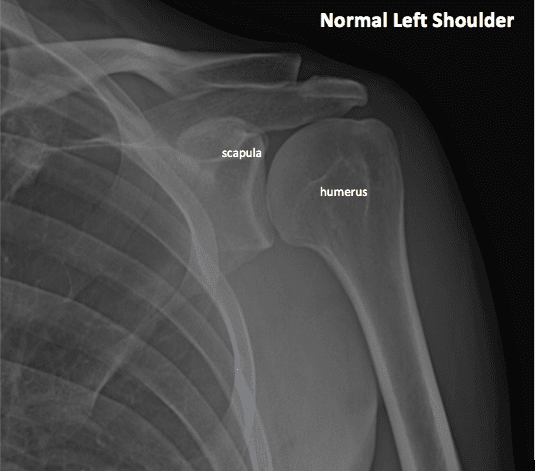
This joint is often referred to as the shoulder ball and socket joint, and provides a large proportion of the movement at the shoulder girdle. This shoulder joint allows the arm to rotate in a circular fashion, or to hinge out and up away from the body. The head of the humerus moves with the glenoid fossa of the scapula and is further supported by the glenoid labrum, a ring of fibrous cartilage which extends the fossa slightly, making it wider and deeper. The shallowness of the fossa, in combination with the relatively loose connections between the shoulder and the rest of the body, allows the arm to have tremendous mobility. However, it is unfortunately at the expense of being much easier to dislocate than other joints in the body.
THE ACROMIOCLAVICULAR JOINT
This joint is located at the top of the shoulder anatomy, and is the junction between the acromion and the clavicle. The joint functions like a pivot point by helping with movement of the scapula, resulting in a great degree of arm rotation. This, in turn, gives us the ability to raise our arms above our heads.
THE STERNOCLAVICULAR JOINT
This joint is at the sterna end of the clavicle, the cartilage of the first rib, and the upper and lateral parts of the sternum. It is the only joint that truly links the upper extremity to the axial skeleton, and is particularly important in throwing and thrusting movements.